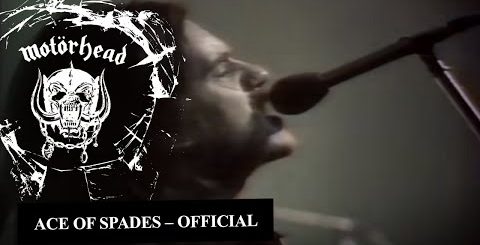
Ace of Spades by Motörhead Lyrics Meaning – Unveiling the Anthemic Ode to Risk and Rebellion
Lyrics
I tell you, I’m your man
You win some, lose some
It’s all the same to me
The pleasure is to play
Makes no difference what you say
I don’t share your greed
The only card I need
Is the Ace of Spades
The Ace of Spades
Playing for the high one
Dancing with the devil
Going with the flow
It’s all a game to me
Seven or eleven
Snake eyes watching you
Double up or quit
Double stake or split
The Ace of Spades
The Ace of Spades
You know I’m born to lose
And gambling’s for fools
But that’s the way I like it, baby
I don’t want to live forever
And don’t forget the joker
Pushing up the ante
I know you got to see me
Read ’em and weep
The dead man’s hand again
I see it in your eyes
Take one look and die
The only thing you see
You know it’s gonna be
The Ace of Spades
The Ace of Spades, uh
In the pantheon of rock anthems, few songs capture the raw edge and the spirit of defiance as potently as Motörhead’s ‘Ace of Spades’. At face value, the track thunders with the adrenaline of high-stakes gambling, but beneath its surface roils a much deeper current of existential philosophy and the human condition. It is a masterpiece that pulses with the rhythm of risk, luck, and the inescapable dance with fate.
Lemmy Kilmister, the gravel-voiced frontman and bassist, penned an anthem that distills the essence of rock ‘n’ roll into a relentless, speeding bullet of a song. But ‘Ace of Spades’ is more than just a hymn to the turn of a card; it’s an attitude, a way of life articulated through blaring amplifiers and relentless riffs. Let’s dive into the undercurrents of Motörhead’s magnum opus and decode the nuances that have made it an immortal classic.
Lemmy’s Lament: The Siren Song of Self-Determination
At its heart, ‘Ace of Spades’ is a declaration of self-agency and an outright rejection of societal norms. The line ‘I don’t share your greed, the only card I need is the Ace of Spades’ signifies a disinterest in the material obsession that grips society. Kilmister’s lyrical prowess shines as he repudiates conventional measures of success, instead finding freedom in the embrace of chaos and chance.
This gambler’s manifesto challenges listeners to cast off the shackles of conformity and embrace a more liberated existence, one where the risks are as thrilling as the rewards. It’s Kilmister’s philosophical gamble—espousing a life lived at full throttle over the illusion of safety sold by societal expectations.
The High-Octane Heartbeat of Rebellion
The relentless, driving beat of ‘Ace of Spades’ encapsulates the ceaseless pulse of a rebel heart. Each stomping beat and thrashing riff heralds a call to arms for those who live on the edge. ‘Playing for the high one, dancing with the devil’ isn’t just about throwing dice or drawing cards; it’s about flirting with the dangers that give life its electric charge.
Embodying the band’s hard-living lifestyle, ‘Ace of Spades’ is an anthem that dismisses the pursuit of longevity in favor of a life rich with experience: ‘I don’t want to live forever’. This assertion strikes a chord with the eternal youthfulness of the rock spirit—an insistence that the quality of existence far outweighs the quantity of years.
The Ace of Spades: More Than Just a Card
The titular ‘Ace of Spades’ serves as a complex symbol throughout the song. In playing cards, the ace can be both high and low, symbolizing the highs and lows of life. The ace of spades, in particular, is known as ‘the death card’—a moniker that further underscores the song’s flirtation with mortality and the random hand we’re dealt.
By making this card the centerpiece of his lyrical chorus, Kilmister imbues it with multi-layered meaning—a talisman for the fearless and a token of life’s inherent uncertainty. The song’s pervasive allusion to the ace is a homage to the art of surviving against the odds, acknowledging that life’s game is rigged, but worth playing nonetheless.
Peering Through the Gambler’s Eyes: Memorable Lines and Hidden Meanings
The climactic verse ‘I see it in your eyes, take one look and die’ goes beyond the bravado of the card table to touch on themes of existential confrontation. These lyrics dig deep, laying bare the human encounter with the unknown. When faced with mortality, one can either cower or stare back with the steely resolve of a gambler willing to bet his soul.
Each iconic line of ‘Ace of Spades’ carries subtext that undulates like the pulsing baseline that drives the song. One can’t help but muse on the implied ‘joker’ Kilmister invokes—a nod to the whims of fate and, perhaps, a sly acknowledgment of his own role as the wild card in the deck of rock history.
An Undying Influence: The Lasting Legacy of ‘Ace of Spades’
‘Ace of Spades’ remains a cultural touchstone, a sonic blast from the past that continues to resonate with new generations. It has transcended its origins, influencing not just musicians but everyone who hears the clarion call of its chorus. This song is more than a fixture on the rock landscape; it is a manifesto that entices you to live with gusto and gamble with whatever hand you’re dealt.
With Kilmister’s passing, ‘Ace of Spades’ has taken on an elegiac quality, but it also serves as a reminder of his indelible impact on music and culture. The song is a parting gift from a man whose life was a testament to the power of authenticity, and it remains a beacon for those who choose to live life on their own rebellious terms.