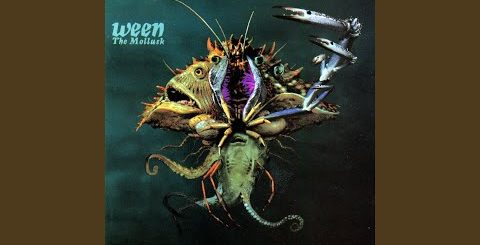
The Mollusk by Ween Lyrics Meaning – Unraveling The Depths of a Nautical Odyssey
Lyrics
Kind sir it’s a mollusk i’ve found
Did you find it in the sandy ground?
Does it emulate the ocean’s sound?
Yes I found it on the ground
Emulating the ocean’s sound
Bring forth the mollusk cast unto me
Let’s be forever let forever be free
Hey little boy come walk with me
And bring your new found mollusk along
Does it speaketh of the trinity
Can it gaze at the sun with its wandering eye
Yes it speaks of the trinity
Casting light at the sun with its wandering eye
Bring forth the mollusk, cast unto me
Let’s be forever let forever be free
You see there are three things that spur the mollusk from the sand
The waking of all creatures that live on the land
And with just one faint glance, back into the sea
The mollusk lingers, with it’s wandering eye
When Ween released ‘The Mollusk’ in 1997, it was received as a curious shift into what appeared to be maritime folklore meshed with psychedelic creativity. But beneath the album’s eclectic veneer lay ‘The Mollusk,’ the title track, which cloaked profound meditations on existence in its seemingly playful verses.
This isn’t merely a sea chantey for the deranged; it’s a patchwork of myth, philosophy, and sensory exploration. The enigmatic two-and-a-half-minute track beckons with the allure of the deep, propelling listeners into a voyage that dares to bridge the mundane with the mystical.
Sailing Through The Verses: A Song’s Superficial Serenity
From the first lines, Ween invites us into what seems a childlike exchange about a simple sea creature. Yet, the idyllic scene sets up a multidimensional narrative, flirting with dualities of simplicity and complexity, innocence and profundity.
The mollusk, an unassuming invertebrate, becomes the pivot around which these concepts revolve. In its modesty lies an emblem of nature’s unfathomable depths and the sound it ’emulates’; a whisper of the boundless ocean, retelling tales as ancient as time itself.
The Mollusk’s Gaze: A Lens into the Cosmic
Particularly entrancing is the mollusk’s ‘wandering eye,’ a motif that recurs throughout the song. In the guise of a children’s rhyme, Ween captures the mollusk’s gaze as a metaphor for the inquisitive human spirit, forever seeking to understand the greater universe.
This roving eye not only ‘speaks of the trinity’—potentially alluding to religious symbolism—but also ‘casts light at the sun,’ implying a defiance common to those who quest beyond the dictated confines of knowledge and existence.
Three Forces That Stir: The Hidden Meaning Within
As the song nears its conclusion, three forces are cited as the catalyst to rouse the mollusk from the sands: the awakening of terrestrial life, the observer’s glance, and an implicit return to the sea. The triad evokes a sense of cyclic movement, intrinsic to many belief systems and reflective of life’s eternal rhythms.
By invoking these elemental triggers, Ween weaves a tapestry where the mollusk is more than mere mollusk; it stands for consciousness itself—emerging from primordial silence, interacting with the terrestrial realm, and then retreating to consider its journey.
Musical Transcendence: ‘Let Forever Be Free’
Accompanying the lyrical journey, Ween employs a lo-fi, nautical soundscape that captures the essence of oceanic vastness. The tranquility of the music juxtaposes with the dense imagery, supporting the song’s message without overpowering it.
The repeated mantra ‘Let’s be forever let forever be free,’ set against this backdrop, becomes an ode to the boundlessness of the ocean—the ultimate symbol of freedom. Its repetition serves as a hypnotic call to break from terrestrial shackles, inviting the listener into infinity.
Eternal Echoes: Memorable Lines That Resonate
‘Does it emulate the ocean’s sound?’ This line encapsulates the song’s central paradox—the human longing to grasp that which is immense and unknowable through the most diminutive of conduits. It speaks of our yearning to capture the essence of the profound within the palm of our hands, a desire as elusive as the ocean’s murmurs.
This echo of the sea, resounding within the shell of the mollusk, resonates as a symbol of universal connection, a reminder that within the smallest fragments of nature lies the echo of the entire cosmos, ever-present and patiently waiting to be perceived.