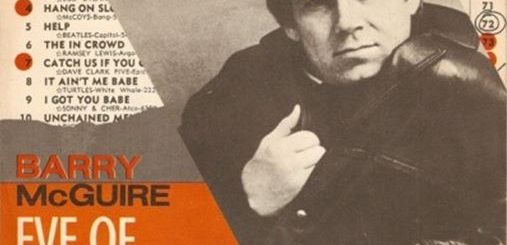
Eve Of Destruction by Barry McGuire Lyrics Meaning – Unpacking the Anthem of Angst and Urgency
Lyrics
Violence flarin’, bullets loadin’,
You’re old enough to kill but not for votin’,
You don’t believe in war, but what’s that gun you’re totin’,
And even the Jordan river has bodies floatin’,
But you tell me over and over and over again my friend,
Ah, you don’t believe we’re on the eve of destruction.
Don’t you understand, what I’m trying to say?
And can’t you feel the fears I’m feeling today?
If the button is pushed, there’s no running away,
There’ll be no one to save with the world in a grave,
Take a look around you, boy, it’s bound to scare you, boy,
And you tell me over and over and over again my friend,
Ah, you don’t believe we’re on the eve of destruction.
Yeah, my blood’s so mad, feels like coagulatin’,
I’m sittin’ here, just contemplatin’,
I can’t twist the truth, it knows no regulation,
Handful of Senators don’t pass legislation,
And marches alone can’t bring integration,
When human respect is disintegratin’,
This whole crazy world is just too frustratin’,
And you tell me over and over and over again my friend,
Ah, you don’t believe we’re on the eve of destruction.
Think of all the hate there is in Red China!
Then take a look around to Selma, Alabama!
Ah, you may leave here, for four days in space,
But when your return, it’s the same old place,
The poundin’ of the drums, the pride and disgrace,
You can bury your dead, but don’t leave a trace,
Hate your next door neighbor, but don’t forget to say grace,
And you tell me over and over and over and over again my friend,
You don’t believe we’re on the eve of destruction.
No, no, you don’t believe we’re on the eve of destruction.
Amidst the cacophony of peace anthems and love ballads that colored the 1960s, Barry McGuire’s ‘Eve of Destruction’ struck a dissonant chord. Releasing in 1965, the song captured the zeitgeist of a generation teetering on the precipice of great social and political upheaval. This was not a song to sway to but one to march with; not one that soothed but that ignited and alarmed.
Throughout its potent verses, ‘Eve of Destruction’ encapsulates the frustration, fear, and the foreboding sense of impending doom felt by many during the era. The song’s stark lyrics reflect the climate of the Cold War, the Civil Rights Movement, and the Vietnam War, compressing a multitude of complex issues into a few minutes of raw, lyrical confrontation.
Decoding the Dire Warning of a World on the Brink
The song opens with an unmistakable signal of chaos, indicating a world ‘explodin’ with unabated violence and tensions rising to their boiling point. McGuire paints a picture of an Earth fraught with paradoxes—old enough to impart death but too young for democracy, proclaiming peace while preparing for war.
With the haunting refrain that ‘we’re on the eve of destruction,’ the song questions the complacency of those who are willing to observe these contradictions without acknowledging the simmering consequences. McGuire’s repetition serves as a chilling reminder that ignorance, in this case, is far from bliss—it’s a willing march towards oblivion.
A Call to Consciousness Amid Cold War Paranoia
McGuire’s lyrics evoke the Cold War’s mortal dread, the claustrophobia of a world where ‘the button is pushed’ and nuclear annihilation is a mere ‘no running away’ from inevitability. It’s a grim portrait of fatalism where the usual sanctuaries offer no shelter, and the specter of death lords over humanity.
Through this visceral depiction, ‘Eve of Destruction’ articulates the paranoia percolating in the public consciousness. The specter of a nuclear ‘world in a grave’ was not merely hyperbole, it was, and to many, still is a potential endgame scenario that could be initiated by the geopolitics of the time.
Unveiling the Hidden Message: A Plea for Human Respect
Beneath the overt political commentary lies a more profound entreaty—a call for human respect. McGuire laments the erosion of civility, the breakdown of communication, and the systemic impediments to justice and equality. ‘Handful of Senators don’t pass legislation,’ and ‘marches alone can’t bring integration,’ he sings, pointing to the action without progress, the motion without movement.
By convicting society of allowing ‘human respect’ to disintegrate, McGuire’s seminal work goes beyond mere protest. It seeks to awaken a moral conscience, to prompt a realization that the unity of humankind is not merely idealistic but urgently necessary for survival.
The Global Gaze: From Red China to Selma, Alabama
McGuire’s lens zooms out to a global perspective and then swiftly narrows to the racial tensions in America. By juxtaposing ‘Red China’ with ‘Selma, Alabama,’ he draws a parallel between the global scale of conflict and the intimate, domestic arenas where hatred and discrimination fester.
This strategic geographical pivot underscores the pervasive nature of the issues he addresses. Whether it’s the looming specter of communist powers or the palpable racial strife in the streets of America, the song demands attention to both the international and the local, the external enemy and the internal divide.
Memorable Lines Cementing a Timeless Relevance
Among the song’s most haunting lines is the conclusion that one can travel ‘for four days in space’, only to return ‘to the same old place.’ This sentiment of stagnation in the face of monumental progress captures the frustration of a generation demanding change.
Furthermore, the poetic irony of ‘hate your next-door neighbor, but don’t forget to say grace’ indicts the hypocrisy of a society that practices piety in façade only. McGuire’s crafting of such lines leaves a lasting impression, serving as a testament to the song’s enduring significance in any era afflicted by turmoil and transformation.