Cruci-fiction in Space by Marilyn Manson Lyrics Meaning – Unraveling the Subversion of Human Progress
Lyrics
The monkey, the man, and then the gun
If Christ was in Texas
The hammer, the sickle, the only son
This is your creation
The Atom of Eden was a bomb
If Jack was the Baptist
We’d drink wine from his head
This is evolution
The monkey, the man, and then the gun
This is evolution
The monkey, the man, and the gun
I am a revolution
Pull my knuckles down, if I could
I am a revelation
And I’m nailed to the Holy Wood
This is evolution
The monkey, the man, and then the gun
This is evolution
The monkey, the man, and the gun
We are dead and tomorrow’s canceled
Because of things we did yesterday
We are dead and tomorrow’s canceled
Crucify us in our space
In our space
In our space
In our space
In our space
In our space
In our space
In our space
This is evolution
The monkey, the man, and then the gun
This is evolution
The monkey, the man, and then the gun
This is evolution
The monkey, the man, and then the gun
This is evolution
The monkey, the man, and then the gun
This is evolution
The monkey, the man, and then the gun
(This is evolution)
(The monkey, the man, and then the gun)
(This is evolution)
(The monkey, the man, and then the gun)
(This is evolution)
(The monkey, the man, and then the gun)
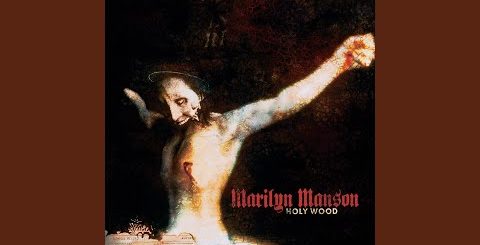
Charting the bold landscape of sonic anarchy, Marilyn Manson’s ‘Cruci-fiction in Space’ from the album ‘Holy Wood (In the Shadow of the Valley of Death)’ presents a searing critique of the human condition and societal constructs. Deriding the supposed linear progression of human evolution, Manson juxtaposes religious iconography with violent historical imagery, to dissect the hypocrisy at the heart of human civilization.
Through the lens of Manson’s unapologetically theatrical and provocative approach, the track becomes a canvas for the examination of conflict, revolution, and the existential void left by the pursuit of power. ‘Cruci-fiction in Space’ is not just a song; it’s a manifesto of disillusionment, beckoning listeners to decode its layered meanings.
The Anthropological Anarchy: From Primates to Projectile
The song opens with a refrain that succinctly traces the so-called ascent of mankind from ‘The monkey, to the man, and then the gun.’ This pithy evolutionary shorthand questions the integrity of human advancement. Is civilization merely a trajectory that inevitably leads to violence and destruction? Manson’s provocative opening screams of disillusionment with a society that equates progress with the proliferation of weaponry and aggression. Through this refrain, Manson issues an audacious challenge to the conventional wisdom that humanity has moved beyond its primal origins.
The repetitive nature of the line enforces the cyclical, rather than linear, nature of human history. Manson seems to imply that despite the pretense of growth and sophistication, mankind is locked in a perpetual cycle where each so-called evolutionary step forward is accompanied by a regression into violence and chaos.
Iconoclasm in Lyrics: Rewriting the Gospel of Power
Manson doesn’t stop at questioning societal progress—he targets religious orthodoxy with his usual irreverence. ‘If Christ was in Texas, The hammer, the sickle, the only son,’ the lyrics intimate a Christ-figure subjected to the whims of societal and political machinations. By setting this scene in Texas, an emblem of both conservative values and the rough justice of the American frontier, Manson portrays a landscape where even the divine is subscript to human predilections for authority and control.
The reference to the hammer and sickle, symbols notably associated with communist ideology, within the same breath as the ‘only son’—an epithet for Jesus—serves to blur the line between political and spiritual salvation. Manson’s lyrics create a subversive tapestry where political figures, revolutionaries, and holy figures are interchangeable, each promising liberation but ultimately wielding power in the same oppressive manner.
Vivisecting Eden: Depicting Destruction as Creation
Manson further unravels the twisted thread of human mythology by reimagining the very beginning—Eden. ‘The Atom of Eden was a bomb,’ he declares, replacing the forbidden fruit with the ominous symbol of the atom bomb. Here, the birth of conscience is conflated with the birth of ultimate destructive power. This paints a bleak portrait of a species whose seminal act of creation is, effectively, one that enables annihilation on a mass scale.
This line is a surgical strike against the sanctity of human genesis stories, repurposing them to comment on the violent capabilities humans harbor. Manson uses this biting imagery to suggest that within the technological and intellectual advancements of humankind lies the seed of our own undoing—the capacity for catastrophic consequences.
The Apocalyptic Aftermath: Tomorrow’s Cancellation
Far from being a distant mythological critique, Manson brings his piercing gaze to the present, or rather its negation, with the stark recognition that ‘We are dead and tomorrow’s canceled because of things we did yesterday.’ His words echo the existentialist notion that as a consequence of our past actions, both individual and collective, we face a future that is, at best, uncertain, and at worst, null.
The duality of irreversibility and nihilism conveyed by these lines captures the core of Manson’s song—a reckoning with the fact that our pursuit of progress has mortgaged our future. This is a call for introspection; a somber acknowledgment that the consequences of human folly are not confined to the past or present, but cast long shadows over the potential for renewal.
Hidden in Harmonic Dissonance: The Song’s Subversive Subtext
Beneath the bombastic exterior and brutal rhythms, ‘Cruci-fiction in Space’ carries a hidden meaning that resonates with an anti-establishment sentiment deeply ingrained in Manson’s work. The song is a call to arms against complacency, urging listeners to question authority, deconstruct societal narratives, and recognize the flaws in our orchestrated histories.
It’s not just a song but an anthem to inspire a revolution of thought and action—a reminder that to progress as a society, we must first confront the uncomfortable truths of our ‘evolution.’ Through stirring up discomfort, Manson seeks not just to entertain, but to enlighten and challenge conventions, pushing his audience towards a more self-aware state of being.