
“El Paso” by Marty Robbins
Anyone who thinks stories of gunslingers and fast women are a more-modern phenomenon in the world of pop music may be surprised to learn that Marty Robbins (1925-1982) had a hit song based on similar themes entitled “El Paso” way back in 1959. However, unlike modern tunes along a similar vein Marty was not idealizing this lifestyle, instead ending the track with somewhat of a moral lesson if you will.
The story begins with the singer spending an evening “in Rosa’s Cantina”, a drinking spot he frequented. And while there he was admiring a lady by the name of “Feleena”, who was a dancer. Indeed he was in love with Feleena. And the reason was that she apparently ‘cast a spell’ on him, with the singer describing her as being “wicked and evil”.
“One night”, while he was chillin’ in Rosa’s Cantina, “a wild young cowboy came in” and started flirting with Feleena, whom once again the singer is in love with. This of course got him angry, so he “challenged” said cowboy to a gun fight, with the victor securing the “right for the love of” Feleena. The cowboy agreed, which led to him swiftly being slain by Marty. And after he realized the evil he had committed, the singer jetted out back of Rosa’s Cantina, jacked a horse and escaped El Paso, making his way into “the badlands of New Mexico”.
However despite apparently successfully making a getaway, his “love” for Feleena was “stronger than (his) fear of death”. In other words, having committed the crimes of murder and horse theft, he knew returning to El Paso was tantamount to a death sentence. However, his feelings for Feleena still compelled him to return to the titular town.
Upon making it back to Rosa’s, he is immediately chased by a posse of almost 20 rowdy “cowboys”. So once again he heads out the back door of the establishment. But this time he does not get far as he feels “a deep burning pain in (his) side” which disallows him from continuing “to ride” on his horse. This burning sensation may have been due to him getting shot, though such is not specified. But eventually he is actually shot, directly in the chest, presumably by one of the members of the aforementioned posse. And upon breathing his last breaths, he does experience a sense of relief as he is “cradled” in the “loving arms” of Feleena, who is “kissing (his) cheek” and in the process imparts him with an especially memorable “little kiss”. So in all he does not seem remorseful that he has made the ultimate sacrifice just for this brief moment of love fulfilled.
Conclusion
In summation, we can conclude that the singer himself is actually the wildest cowboy in this narrative. “El Paso”, which is comprised of 13 verses, comes from an era when radio was more pervasive than television. And accordingly, the song reads like true auditory cinema, like a classic Western film. And although the tales of the singer and even the cowboy he murdered are quite tragic, there does not seem to be an overt effort to relay any particular moral lesson. But this song does feature an entertaining and easy-to-follow storyline from beginning to end, making it a timeless masterpiece in the art of musical storytelling.

Who wrote “El Paso”?
“El Paso” was written by its singer, Marty Robbins. He did so while literally traveling through Texas (specifically from Nashville, Tennessee to his hometown of Phoenix, Arizona to celebrate Christmas) with his family. Marty’s specific inspiration for writing the song was the view of the cities of El Paso of Texas and Juarez of Mexico as he drove down the Carlsbad Highway. By the time he had reached his destination, he had finished penning the first draft of the hit. It reportedly took him three years to finish writing the entire song. The song went on to become the signature song of his distinguished career.
FYI: Much to the dislike of Robbins’ label (Columbia Records), the final product proved to be nearly five minutes in length. This was considerably longer than standard pop songs of that era. Owing to this, Columbia decided to release a shorter (more radio-friendlier) version of the track. However, the label got it all wrong. And why was this so? This was because the full-length version ended up proving to be more endeared by fans.
And by the way, “El Paso” was produced by the late record producer Don Law (1902-1982).
When was “El Paso” released?
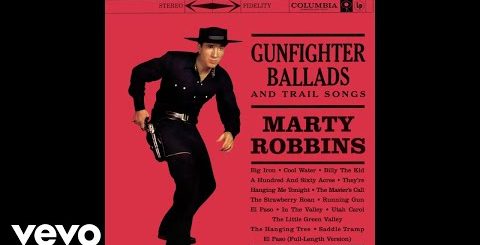
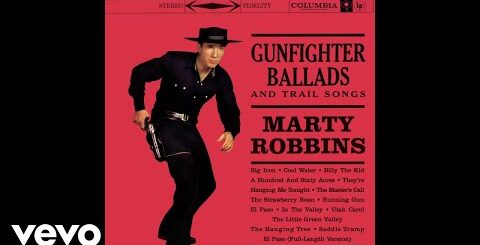
Mary Robbins released this classic through Columbia Records during September of 1959. The song was part of his amply-named album Gunfighter Ballads and Trail Songs.
That said, it should be noted that there have been two official sequels to “El Paso”, both written by Marty Robbins. The first, which came out in 1966, was entitled “Feleena (From El Paso)”. The second, which was titled “El Paso City”, made its first appearance in 1976.
Appearance on Breaking Bad
This song influenced and was featured on the series finale of the hit television show Breaking Bad. For instance that particular episode, which aired in September of 2013, was entitled “Felina”. The title “Felina” was derived from the character Feleena from “El Paso”.
Accolades
- In 1961 “El Paso” won Marty a Grammy Award. Actually, it won Marty the first Grammy ever issued in the category of Best Country & Western Performance.
- It also scored a number 1 on Billboard’s Hot Country & Western Sides and more importantly replicated this feat on the Hot 100.
- And in terms of distinguished lists, “El Paso” was ranked at number 55 on Rolling Stone’s 2014 compilation of the “100 Greatest Country Songs of All Time”. Furthermore, in 2010, it made it onto the Western Writers of America’s list of “The Top 100 Western Songs”.
Notable Covers of “El Paso”
This song was a favorite of the iconic rock band Grateful Dead. The band reportedly played it live almost 400 times between 1969 and 1995. Indeed Grateful Dead member Bob Weir referred to it as the bands’ “most requested number”.
Other prominent artists who have covered “El Paso” include:
- Pat Boone
- John Denver
- Elvis Presley
Who was Feleena? Was she a real person?
The character Feleena who actually stars in the song was based on a schoolmate Robbins had during his youth. Interestingly enough, her name was Fidelina Martinez.





isnt it possible that feleena actually killed marty in the song elpaso
I would say that is possible- I had never thought of that. I suppose it is also debatable as to whether Feleena actually appears in the final scene, or if it that part is just a dream.
How long was “the lovesick cowboy” away from El Paso before returning and being killed by the posse. Was the posse of 17+ out looking for him all that time? It seems inconsistent that the cowboy was in the Badlands of New Mexico and these cowboys were looking for him all that time.
“Back in El Paso my life would be worthless
Everything’s gone in life; nothing is left
It’s been so long since I’ve seen the young maiden
My love is stronger than my fear of death”
To be picky, one could suppose that the “lovesick cowboy” did not actually die at the end of the song. The narration is in first person, so the narrator couldn’t report his own death. Perhaps he was convinced that he would die; perhaps he was nursed back to health by Faleena.
Would he have been charged with murder for killing a man in a ‘fair fight’?