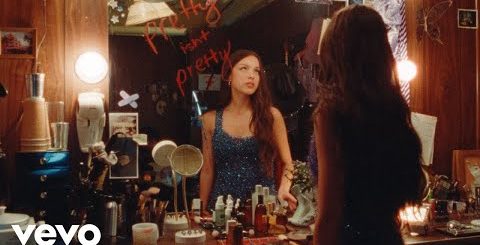
brutal by Olivia Rodrigo Lyrics Meaning – A Dissection of Youthful Angst and Modern Teen Tribulations
- Music Video
- Lyrics
-
Song Meaning
- The Anthem of a Generation: More Than Just Teenage Discontent
- From Lyrics to Confessions: The Visceral Honesty of Rodrigo’s Wordcraft
- The Soundscape of Struggle: How Music Emboldens the Message
- Decoding the Silent Screams: The Hidden Meanings Within
- Unforgettable Lamentations: The Lines That Define a Disenchanted Youth
Lyrics
I’m so insecure, I think
That I’ll die before I drink
And I’m so caught up in the news
Of who likes me, and who hates you
And I’m so tired that I might
Quit my job, start a new life
And they’d all be so disappointed
‘Cause who am I, if not exploited
And I’m so sick of seventeen
Where’s my fucking teenage dream?
If someone tells me one more time
“Enjoy your youth”, I’m gonna cry
And I don’t stick up for myself
I’m anxious and nothing can help
And I wish I’d done this before
And I wish people liked me more
All I did was try my best
This the kinda thanks I get?
Unrelentlessly upset (uh-uh, oh)
They say these are the golden years
But I wish I could disappear
Ego crush is so severe
God, it’s brutal out here
(Yeah)
I feel like no one wants me
And I hate the way I’m perceived
I only have two real friends
And lately, I’m a nervous wreck
‘Cause I love people I don’t like
And I hate every song I write
And I’m not cool, and I’m not smart
And I can’t even parallel park
All I did was try my best
This the kinda thanks I get?
Unrelentlessly upset (uh-uh, oh)
They say these are the golden years
But I wish I could disappear
Ego crush is so severe
God, it’s brutal out here
(Yeah)
(She’s having a really good time)
Got a broken ego, broken heart
And God, I don’t even know where to start
Peering through the looking glass of contemporary adolescence, Olivia Rodrigo’s ‘brutal’ presents a visceral landscape of the Gen Z experience. The track is a blistering nod to the angst and frustrations that bubble under the surface of youthful exteriors, capturing the chaotic essence of being seventeen in a world that’s unforgivingly public and relentlessly critical.
Rodrigo, with her poignant songwriting, taps into a collective vein of vulnerability and raw candor that resonates with her audience on a personal level. As we dissect the layers beneath Rodrigo’s riff-heavy outcry, we discover more than a teenage rant; it’s a mirror to the complexities of growing up in the social media era.
The Anthem of a Generation: More Than Just Teenage Discontent
At first glance, ‘brutal’ might register as a modern rebel yell, a flag planted by and for those mired in the trials of high school life. But Olivia Rodrigo is no ordinary banner bearer. By channeling her insecurities and pressures into a two-minute punk-infused confession, Rodrigo becomes a spokesperson for a demographic grappling with the accelerated rhythms of growing up online.
The universality of the song’s sentiment owes to its sharp revelation of ubiquitous internal battles: facing down self-doubt, striving for individuality, and committing to self-representation amidst ubiquitous criticism. It’s here that ‘brutal’ morphs from being a simple entry in the lexicon of teen woes to an empathic expression of shared experience.
From Lyrics to Confessions: The Visceral Honesty of Rodrigo’s Wordcraft
Each lyric in ‘brutal’ is a confessional dart aimed straight for the heart of the matter. Rodrigo doesn’t just sing words; she testifies with the anguish and bravado of a generation that has had to contend with instant judgment in the court of public opinion. With the declaration ‘I’m so insecure, I think/That I’ll die before I drink’ she captures a sense of hyperbolic dread that rings eerily true in the age of anxiety.
Her words paint a landscape that is at once deeply personal but expansively relatable. With lines like ‘And I’m so sick of seventeen/Where’s my fucking teenage dream?’ Rodrigo delivers a powerful indictment of the failed promises peddled to youth, the disconnect between expectation and reality that leaves many feeling adrift in their formative years.
The Soundscape of Struggle: How Music Emboldens the Message
It would be a disservice to the song’s impact to ignore the role of its grungy, alt-rock influence. ‘brutal’ speaks in the crackling language of electric guitars and pounding drums, a throwback to the punk era that eschews polished production for something that feels more immediate and raw. It’s this sonic abrasiveness that underscores the agitation in Rodrigo’s lyrics, making for an experience that’s as immersive as it is unsettling.
The music propels the narrative forward, each strum and beat resonating with the turbulence of adolescence. With a sound that feels at once nostalgic and fresh, ‘brutal’ presents a dichotomy that parallels the complex nature of modern teenhood, reaching back to the emotional resonance of past genres while forging ahead into uncharted lyrical territory.
Decoding the Silent Screams: The Hidden Meanings Within
Beyond its surface angst, ‘brutal’ holds hidden depths. A close listener might detect the subtle commentary on a culture that commodifies young fame and the tender, often explosive, psyches behind it (”Cause who am I, if not exploited’). Rodrigo’s lyrics reveal an environment where self-worth is often distilled to metrics of likes and follows, a brutal truth about the digital age’s impact on personal value.
The song’s introspective nature is a soliloquy of self-evaluation fraught with the pressure to be more and the dread of underachieving (‘And I wish people liked me more’). It’s a contemplation that rivals the poetic musings of literary figures, an exploration of one’s relationship with self in a world where that self is perpetually on display and subject to scrutiny.
Unforgettable Lamentations: The Lines That Define a Disenchanted Youth
‘Ego crush is so severe/God, it’s brutal out here’ — with these words, Rodrigo captures the zeitgeist of a cohort straining under the weight of hyper-constructed social personas and the constant chase for validation. These lines, far from being mere lyrics, are the mantras of a generation desperate for authenticity in an increasingly artificial social terrain.
It’s not just a personal narrative that Rodrigo is outlining, it’s a shared emotional tapestry. Each memorable line is a thread in the fabric of contemporary youth culture, a cultural signpost that encapsulates the zeitgeist with the succinctness and potency of a modern-day Shakespearean soliloquy.