Courtesy Laughs by Phoenix Lyrics Meaning – Decoding the Layers of Melodic Introspection
Lyrics
I didn’t think it would be that hard
You get to do what you want now
Though we’ll always have to do it apart
I’m gonna scream a hundred thousand words
Now that your fever is long gone
Your wishes I couldn’t tell, see
I don’t hear you talking but pretending
Ain’t that enough courtesy laughs
I read my future in a fortune cookie
Without any safety procedure in mind
All of your things in the main hall
You told me to get rid of them, so
Sold an ugly necklace uptown
I found out it was Egyptian
I tied up your letters
Buried them all with delectation
Ain’t that enough courtesy laughs
I hate that kind of wrong affection
I ain’t ready to talk at all
It’s all lies, misunderstandings
I’m all alone in the main hall
I’m gonna read every novel you read
I’m gonna learn what’s Egyptian
Pretend not to talk too much too
Sacrifice all of my agenda
I had a fever to empty your closet
I didn’t think it would be that hard
You get to do what you want now
Though we’ll always have to do it apart
I hate that kind of wrong affection
I ain’t ready to talk at all
It’s all lies, misunderstandings
I’m all alone in the main hall
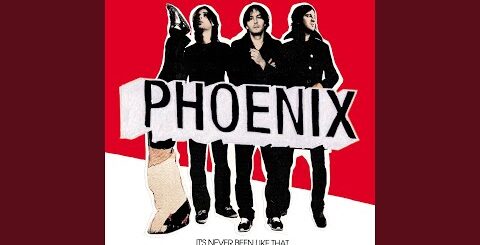
Phoenix’s track ‘Courtesy Laughs’ from their 2006 album ‘It’s Never Been Like That’ unravels the tale of personal growth amid the ruins of a relational fallout. Beneath the vibrant melody, there’s a potent mosaic of emotions and stark reflections that mirror the complexities of moving on.
Embracing the bittersweet journey of self-discovery and the haunting remnants of past relations, ‘Courtesy Laughs’ serves a dual narrative: an overt one that charts the end of a connection, and an obscure layer that delves deep into the psychological transformation arising from such an experience.
Unpacking the Closet of the Mind: A Metaphor for Letting Go
The track opens with a fretful attempt to empty a closet, a seemingly simple task shadowed by emotional weight. This closet, laden with the belongings of a previous partner, symbolizes the burdensome task of decluttering one’s internal psyche. Stripping away the artifacts is parallel to the arduous process of letting go of memories, intimately tied to possessions and spaces once shared.
In expunging these belongings, the song’s persona confronts the duality of freedom and loss: the partner is now free to explore life unrestrained by the past, yet this newfound liberation is tainted with a wistful undertone. They part ways, but only ever in spirit—physically bound by a shared narrative that time can’t dissolve.
The Feverish Outpour of Surrendered Expressions
The protagonist pledges to unleash a vociferous torrent of pent-up words, a symbolic fever representing their suppressed emotions now ebbing away. This confession of silent endurance, where wishes and voices faded into oblivion, highlights the strain of a relationship where communication has failed, leaving only the courtesy of pretense.
The admission of ‘pretending’ circles back to the courtesy laughs, a facade maintained to appease societal expectations or perhaps an internal defense mechanism to cushion the blow of what’s been left unsaid. They are the reactions prompted not by humor but by social convenience, painting smiles on faces that scream in silence.
The Poetic Irony of Love: Memorable Lines Dissected
Lines such as ‘Sold an ugly necklace uptown / I found out it was Egyptian’ deliver a poetic punch. The discovery of the necklace’s origin post-sale is a metaphor for the retrospect clarity in relationships. Only with distance do we see the true cultural and emotional value of what we once possessed, often discarding something precious unknowingly in an effort to heal.
Similarly, the act of tying up letters and burying them ‘with delectation’ demonstrates a pleasure derived from finally taking control of the past, laying it to rest with a ceremonious farewell. It’s about finding joy in the autonomy of grief, engaging with closure in an intensely personal, almost indulgent, manner.
The Hidden Meaning: Wrong Affection and the Path to Solitude
The singer’s reference to hating ‘that kind of wrong affection’ underpins the tragedy of misaligned love—a sentiment that masquerades as compatibility but culminates in misunderstanding and isolation. It’s a love that has soured, one that once compelled conversation but now forces silence.
Phoenix cleverly interweaves this complexity with the notion of self-imposed solitude in the ‘main hall,’ which is metaphorically representative of the vastness of the mind or heart. Amidst this spacious ‘hall,’ the protagonist is left to navigate the echoes of what was once filled with the presence of another.
Decoding Egyptian Symbolism and the Quest for Identity
Curiously, the recurring theme of Egyptian artifacts weaves a mystical element through the narrative. The necklace’s late revelation parallels the idea that some aspects of ourselves or our partners become apparent only in the absence. The dedication to ‘learn what’s Egyptian’ bespeaks a desire to understand the enigmatic, the commitment to personal growth rooted in the deep dive into the unknown.
The character’s choice to consume every novel once read by their former companion is an act of alignment or even subsumption. In this quest for identity, they grapple with adopting traits of the lost love, perhaps hoping to hold onto fragments of a shared past, or conversely, to evolve beyond it, informed but not defined by echoes of affinity.