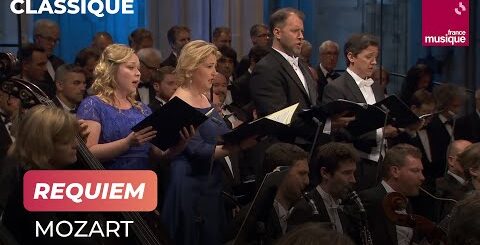
Lacrimosa by Wolfgang Amadeus Mozart Lyrics Meaning – Unraveling the Mystique of Death and Divine Mercy
- Music Video
- Lyrics
-
Song Meaning
- The Echo of the Last Day: What Lacrimosa Really Tells Us
- A Melodic Plea for Mercy: Deciphering the Divine Request
- Behind the Veil of Composition: Mozart’s Unfinished Testament
- The Weight of the Words: Memorable Lines That Defy Time
- Uncovering the Hidden Layers: The Mystical Union of Words and Harmony
Lyrics
qua resurget ex favilla
judicandus homo reus.
Huic ergo parce Deus,
pie Jesu Domine,
dona eis requiem! Amen!
It’s a piece that has permeated the collective consciousness, a work seeped in the grandeur of grief and the solemnity of judgment. Lacrimosa, part of Wolfgang Amadeus Mozart’s magnum opus, the Requiem Mass in D minor (K. 626), stands out not just for its haunting melody but for the profound depth of its lyrics. As listeners, we are invited into the heart of human vulnerability, confronting our morality through the prism of Mozart’s genius.
The completion of the Requiem remains shrouded in mystery, wrapped up in the final days of Mozart’s own life. Yet, even in its unfinished state, Lacrimosa offers a window into themes of life, death, and the prospect of divine forgiveness. We explore the layers stitched into the fabric of these potent lyrics, distilled from Latin liturgy, and elevated by Mozart’s extraordinary composition.
The Echo of the Last Day: What Lacrimosa Really Tells Us
On a surface level, the Lacrimosa lyrics draw their subject from the Latin Mass for the Dead – specifically from the sequence known as the Dies Irae. The text speaks of the Day of Judgment, a day suffused with tears (‘Lacrimosa dies illa’), when mankind arises from the ashes to be judged. This poignant imagery conjures a visceral emotional response, matched by the ebbing and flowing of Mozart’s choral waves.
Yet there’s more at play than mere reflections on doomsday. In Lacrimosa, Mozart grapples with the universality of human transgression (‘judicandus homo reus’). It’s a stark reminder of our shared fate and the intrinsic yearning for redemption, a sentiment that resonates across cultures and epochs, making this piece as relevant today as it was in 1791.
A Melodic Plea for Mercy: Deciphering the Divine Request
While the mention of judgment and ashes may elicit a sense of fear, the latter part of the lyrics introduces a tonal shift. The plea ‘Huic ergo parce Deus’ – ‘Therefore, spare him, O God’ – interwoven with Mozart’s delicate orchestration and vocal finesse, transforms the narrative into one of hope and supplication for mercy.
This prayerful entreaty is directed towards a ‘pie Jesu Domine,’ a compassionate Jesus Christ as Lord, who is implored to ‘dona eis requiem,’ to grant eternal rest. Here, Mozart touches on the dual nature of divinity as both judge and redeemer, capable of strict justice and boundless grace.
Behind the Veil of Composition: Mozart’s Unfinished Testament
Lacrimosa holds a special place in the Requiem as the last section Mozart worked on before his death, capturing an artist in his final creative throes. Embedded within the soaring melodies, one can’t help but speculate on the personal reflections of a man confronted with his mortality. Was Mozart, through his composition, wrestling with his fate, seeking absolution in his last breaths?
The raw emotion interlaced with technical precision in Lacrimosa ignites the imagination, suggesting a dual narrative – one of a fictional judgment day, the other a very real artistic reckoning. It’s an unfinished symphony that’s somber yet hopeful, meditative yet charged, and above all, deeply personal.
The Weight of the Words: Memorable Lines That Defy Time
The lyrics of Lacrimosa are brief, yet each word carries a gravity that has echoed through the centuries. ‘Resurget ex favilla’ – ‘He shall rise from the ashes’ – strikes a particularly resonant chord, pointing to the phoenix-like transformation that awaits in the afterlife.
Yet it’s the choral repetition of ‘Amen’ that delivers the simplest and most profound finale. It’s an affirmation, an acceptance of all that has been pleaded before, leaving listeners in a state of contemplative silence. Through these lines, Mozart weaves a liturgical poem into an existential tapestry, one that each of us is invited to ponder.
Uncovering the Hidden Layers: The Mystical Union of Words and Harmony
To understand Lacrimosa’s full impact, one must not only dissect the lyrics but also delve into the symbiotic relationship with the music. Each note, each rest, is meticulously crafted to elucidate a deeper meaning beneath the text. The sorrow in ‘lacrimosa’ is palpable through the sweeping strings, the pleading ‘huic ergo parce Deus’ is underscored by a gentle yet imploring melody.
There exists in this composition a fine balance between expression and restraint, a delicate dance that accentuates the thematic dichotomy of divine wrath and mercy. Through this union, Mozart transcends the role of composer and enters the realm of philosopher-poet, presenting a work that prompts introspection on the human condition and our place in the cosmos.