Seven Swans by Sufjan Stevens Lyrics Meaning – Unraveling the Mystique of Spiritual Transformation
Lyrics
There was a fire in the yard.
All of the tress were in light.
They had no faces to show.
I saw a sign in the sky:
Seven swans, seven swans, seven swans.
I heard a voice in my mind:
“I will try, I will try, I will try.
I will try, I will try, I will try.”
We saw the dragon move down.
My father burned into coal.
My mother saw it from far.
She took her purse to the bed.
I saw a sign in the sky:
Seven horns, seven horns, seven horns.
I heard a voice in my mind:
“I am Lord, I am Lord, I am Lord.”
He said: “I am Lord, I am Lord, I am Lord.”
He said: “I am Lord, I am Lord, I am Lord.”
He will take you. If you run,
He will chase you.
He will take you. If you run,
He will chase you.
Cause he is the Lord.
Beneath the delicate strumming, the soft whispers of the banjo, and the tender crooning of Sufjan Stevens lies ‘Seven Swans,’ a track as enigmatic as it is spiritually charged. In a world cluttered with noise and the mundane, Stevens reaches into the depths of allegory, drawing listeners into a contemplative journey framed by biblical allegories and a search for meaning.
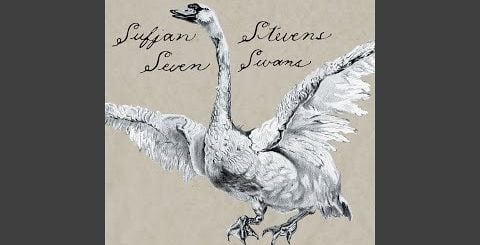
On the surface, ‘Seven Swans’ could be misconstrued as a minimalist composition from his 2004 album of the same name, but the ethereality of the music belies a deeply rooted narrative, one that examines life, death, and transcendence. The swans in Stevens’s sky carry a weight heavier than feathers; they are bearers of a message that transcends the literal, inviting those who hear their wings to explore the ethereal realms of faith and existential wonder.
The Fire’s Embrace: A Metaphor for Change
With the opening line, ‘We didn’t sleep too late,’ listeners are thrust awake into a scene of revelation. There’s a fire—not of destruction, but illumination. As it licks at the very essence of the trees, it strips them of their worldly identities, leaving them ‘with no faces to show.’ Here, Stevens isn’t just setting a scene; he’s hinting at spiritual renewal, a purifying blaze that cleanses perception, allowing for rebirth.
The fire serves as a catalyst, a necessary purge to pave the way for the celestial vision that follows. One cannot help but feel the intensity of these flames, the way they engulf the comfortable norms by which we recognize life, sharpening our focus towards what lies beyond, towards the heavens where seven swans glide with a message.
Seven Swans Ascending: A Dive into Numerology and Prophecy
The seven swans cast a chilling but serene spell against the backdrop of a sky that serves as both canvas and portal. The number seven echoes throughout religious and historical texts as a symbol of completeness, spiritual perfection, and revelation. Stevens beckons us to heed the sign, to see beyond the physical swans to the serrated-edged horizons of the apocalypse and the ultimate reckoning.
In Christian scripture, the swan—a creature of beauty and lore—rarely makes an appearance, but the number projects its meaning onto these birds, transforming them into prophetic messengers. When Stevens hears the voice, ‘I will try, I will try, I will try,’ it opens a dialogue with the divine, a promise to endeavor toward understanding the ineffable, to struggle with the flesh and the spirit.
The Lord’s Echoing Assertion: Struggle between Submission and Sovereignty
As the voice changes from a personal vow of perseverance to a divine proclamation, ‘I am Lord, I am Lord, I am Lord,’ Stevens doesn’t just declare sovereignty but etches it into the sky itself. The threefold repetition isn’t redundant; it’s a sacred affirmation, a trinity of certainty in the power and presence of the deity.
This divine claim rattles the core of human autonomy, positioning the Lord as the absolute, juxtaposed against the fragility and volatility of human life, illustrated by the imagery of the father turned to coal, the mother clutching her purse to the bed. It’s a stark reminder of mortality and the overpowering might of the divine presence Stevens conjures in the song.
A Familial Tableau: Mortality and the Image of the Dragon
When the swans morph into ‘seven horns’ and the dragon descends, the symbolism deepens. Dragons often represent chaos and destruction, and it’s here that Stevens touches upon the perilous dance between life and its inevitable end. The father’s transformation into coal is a rich image—a life energy fueling something new, perhaps, or a consumption by the very fire that once enlightened.
Stevens’s mother perceives the dragon from afar and retreats to her bed with her belongings—a place of perceived safety and a grip on the material in the face of the sublime and terrifying. Her action encapsulates the human impulse to withdraw and protect in response to overwhelming spiritual revelation and the physical manifestation of otherworldly power.
The Pursuit of the Divine: The Inescapable Presence of the Lord
The lyrical mantra, ‘He will take you. If you run, He will chase you,’ transforms the song into a divine chase, a hunter and the hunted scenario where escape from the omnipresent is futile. This looping verse serves as a reminder of the inescapability of divine pursuit, wherein running only beckons a closer encounter with the absolute.
Stevens, in his repetition, delves into the essence of true surrender to the divine, suggesting that to run from it is to engage with it—deepening the connection, not severing it. It’s a staggering portrayal of the reluctant intimacy between humanity and the divinity that seeks it, and with the final grounding assertion, ‘Cause he is the Lord,’ Stevens leaves listeners lingering in the wake of his spiritual soundscape, contemplating their own place beneath the sign of the seven swans.